“She moved again! Never at the same spot for too long ya know,” so said a local Hanoian friend, when I yet again queried about Bún bò Nam Bộ Hải Sẹo (25 Phùng Hưng Street, Hàng Bồ Ward, Hoàn Kiếm District, Hà Nội), what I consider the place to try Hanoi’s least understood beef vermicelli dish, Bún bò Nam Bộ.
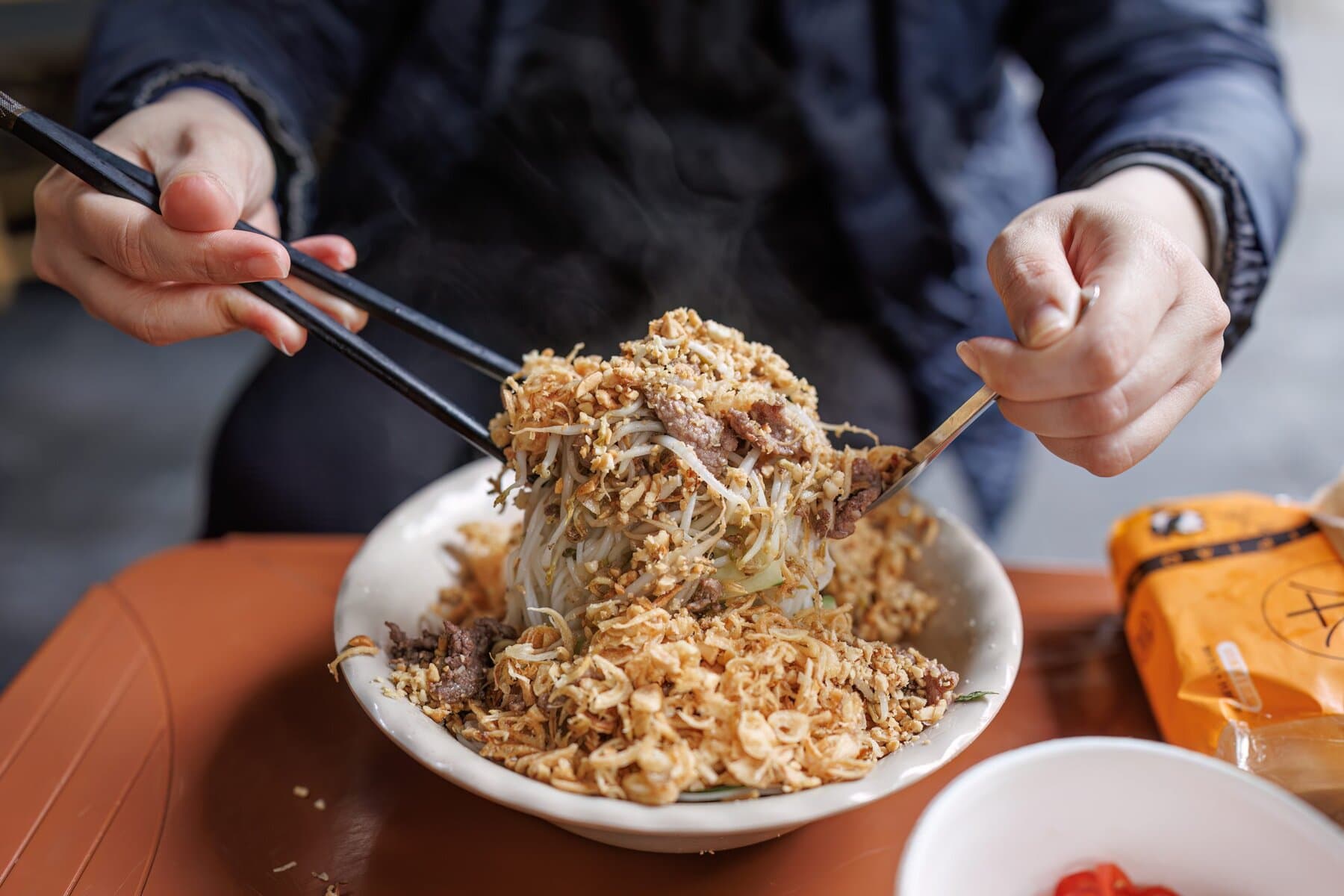
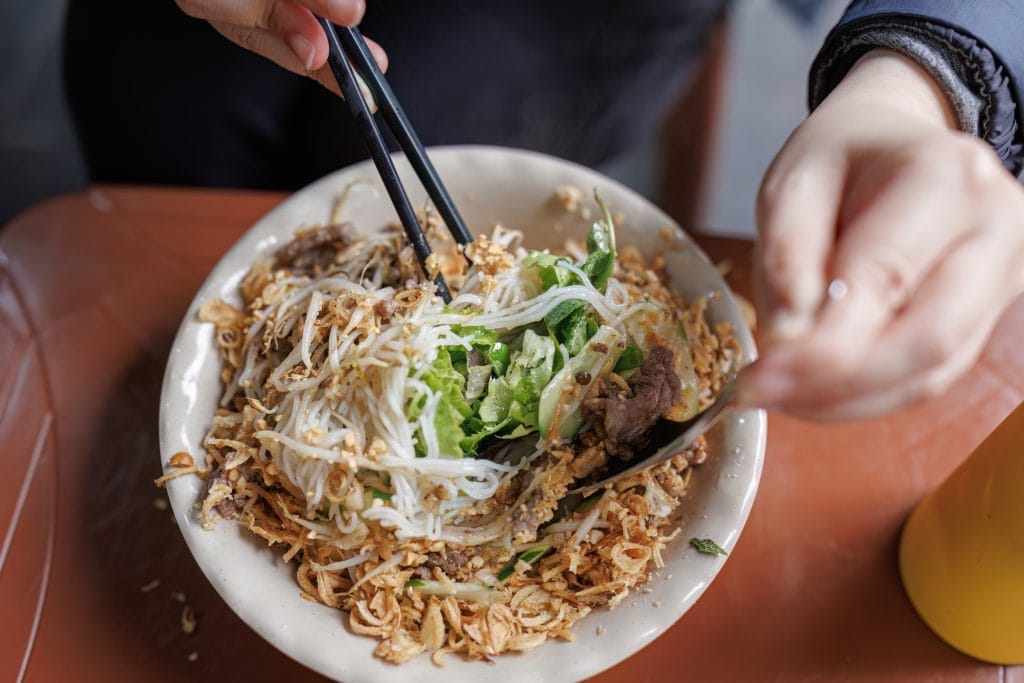
Condiments may vary, but Vietnamese fresh bún rice noodle is topped with thinly sliced pieces of beef shank stir-fried with oyster sauce, garlic, beansprouts, and onions, then finished with raw vegetables, pickles, herbs, deep-fried shallots, toasted peanuts, and a dish-defining boiled fish sauce mix containing sugar and a touch of vinegar.
(Let me catch my breath from this long culinary sentence.)
And, a hot sauce that resembles the stuff served with Northern-style phở is also typical on the side.
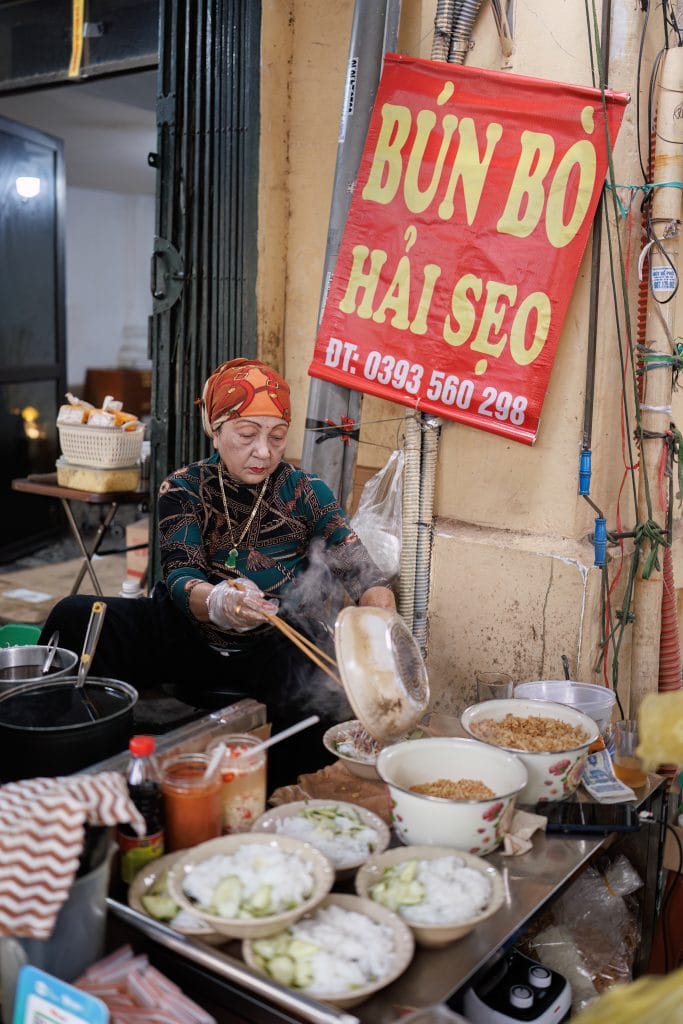
Purportedly either the second, or perhaps third, matriarchal character to serve up Bún bò Nam Bộ in its current state since the early 1980s, madam Hải Sẹo, best translated to scarred madam Hải (owing to a large scar on her arm from a petrol-related childhood accident), is also part-Indian, sports a bindi, and has a prolific past that’s cinema-worthy — a big reason why she’s always moving around. Do take note that the google map photos are thus usually pictures of her previous haunt.
But hey, all she needs is her makeshift smoke chimney and a trusted topping lady.

Bún bò Nam Bộ is somewhat of a mystery, but there are oft-suggested theories
Most visitors in Hanoi will inadvertently be recommended Bách Phương (73-75 Hàng Điếu, Cửa Đông, Hoàn Kiếm, Hà Nội) to sample the dish, but I prefer explorative measures when it comes to street cuisine.
I find the beef vermicelli here at Bún Bò Nam Bộ Hải Sẹo to have a rounder flavor, with no component too jarring, and not as uncomfortably sweet for my palate. It’s also nearly half the price (VND50,000 vs VND80,000). It’s not that I’m a miser since I believe in paying for great food, but I’m sure some readers might wanna know.
Anyway, history buffs insist that the dish got its name from Nam Bộ street, meaning southern region street, which is now named Lê Duẩn.
Interestingly, Lê Duẩn street is also home to the Hanoi railway station, with other accompanying theories aptly suggesting that migrants from the central and southern regions of the country purveyed a similar dish in the vicinity. Very convincing to be honest, since dishes like bún thịt bò xào (vermicelli served with stir-fried beef) are common in the southern reaches of the country.
I spoke to Madam Hải Sẹo to verify these theories and received detailed culinary insights in return.
“My grandmother arrived from the south in 1954 where she taught my mother how to make the dish which was much more complicated than it is today,” she explained.
There were no cucumbers, and pickles were made from grated turnip. Today’s phở-style chilli sauce was merely a convenient replacement for the original spicy preserve made from ground chilli peppers slow-cooked in fish sauce and sugar.
First selling from a carry pole on Hàng Cá street where a hearty bowl of bún bò Nam Bộ was just 1 xu (1 cent/VND 0.01), her mother moved the sidewalk business to Lãn Ông street, once the centre of commerce for Chinese traders from Fujian, before finally setting up a shop at Number 4 Đường Thành Street.
After the lease ended, Madam Hải Sẹo took a decade long sabbatical before resuming in 2022.
Where else to try delicious Bún bò Nam Bộ in Hanoi?

Ultimately, it’s a dish that’s perhaps not the best representation of Hanoian cuisine, but yet a great summary of the Vietnamese palate without being too awkwardly stereotypical — a mix of both raw and cooked aromatic vegetal components, humble yet fulfilling serving of meat, and tossed with crunchy bits for an all-round textural experience.
Down in Hai Bà Trưng district south of Hoàn Kiếm lake, you’ll also find great renditions of the dish at Bún Bò Cô Tuân and Bún Thang Cô Nhung 11 Hạ Hồi, which also served Hanoian-style pork hủ tíu and bún thang respectively.