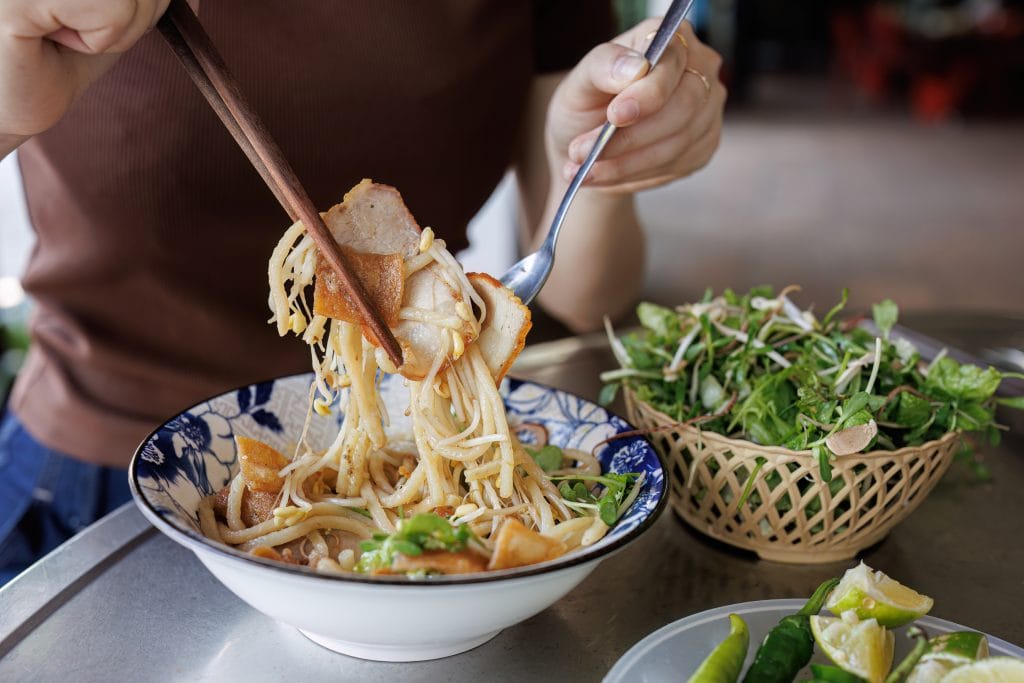
Sometimes it’s difficult to identify a dish that represents a particular town, city or province in Vietnam, but for Hội An, the locals’ opinion seems to be that you’ve not visited unless you’ve tucked into a bowl of Cao Lầu.
Often heralded as a beautiful “fusion” between Faifo’s trade-era Vietnamese, Champa, Chinese, and Japanese culinary traditions, wood ash from a very specific cây thông tree that purportedly only grows on Cù Lao Chàm island is burnt to a clean white as the alkaline base for water used to make Cao Lầu’s rice noodles.

After allowing ashwater to work its magic in a batter made with freshly ground local rice, the entire mixture is then steamed into a semi-finished dough-like mass that is then pressed into sheets before being cut into strands with a thickness comparable to Japanese udon.
Because of a mix of regional ingredients and a unique manufacturing process, Cao lầu noodles feature a unique “snappy” consistency that is both soft yet firm at the same time.
Yet the excellence of the dish does not stop at the near-mythical making process — herbs, toppings and sauce then add immense character to one of Vietnam’s favorite regional noodle dishes.
Saucefish visited Hội An’s old town just to talk to the masters for a glimpse of Cao Lầu perfection and 3 places to try Hội An’s favorite noodle.
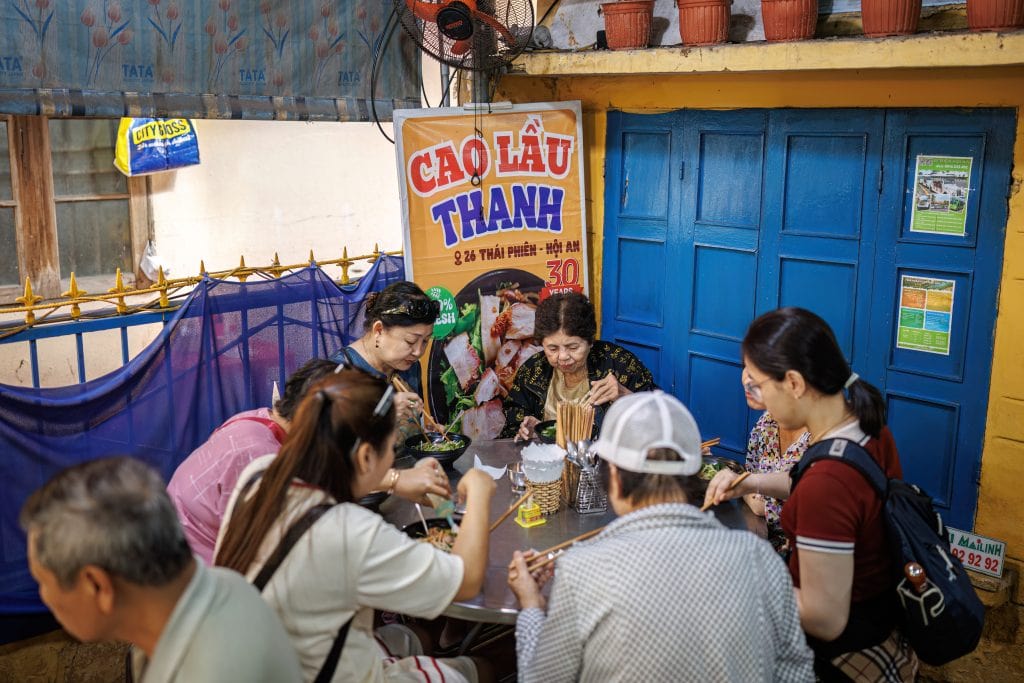
Quán Cao Lầu Thanh, the perpetual old town favourite
I vaguely remember a moment 10 years ago on the first instance I visited this humble joint — a local tour guide was expressing her love for Cao Lầu to a visiting couple.
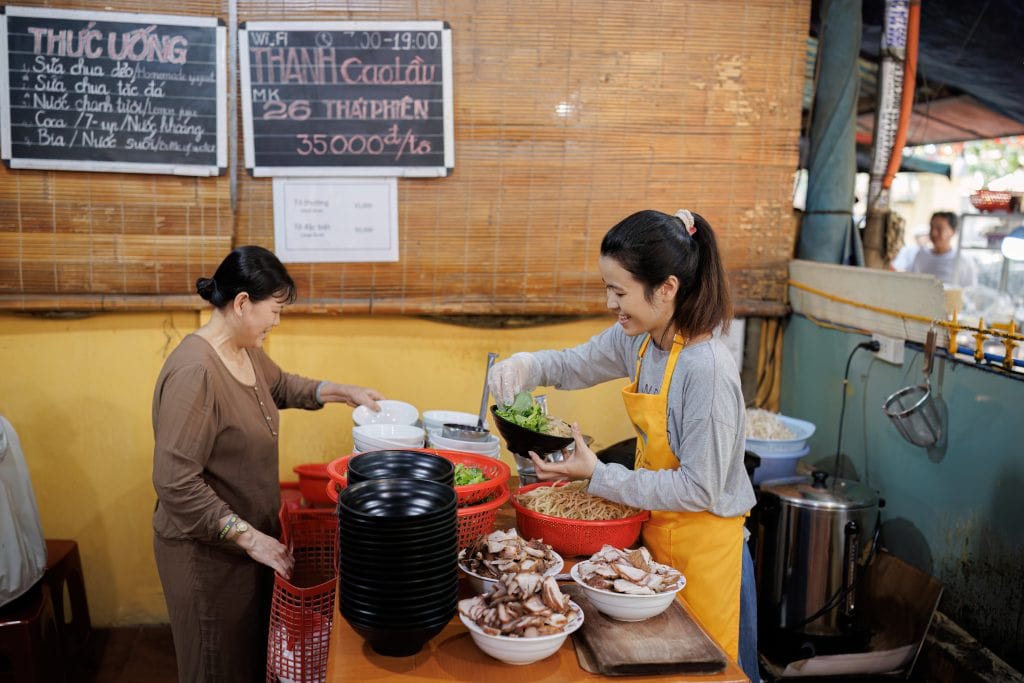
“The savoriness of the sauce, the braised pork, the crispy bits, it comes together like nothing else,” she said, as precisely as I could possibly remember from a decade before.
Part of the allure of Cao lầu is ram or tép, deep-fried “croutons” of the same noodle dough that expand into tiny pockets of crunchiness after being fried.
Yet the show-stopping topping at Cao Lầu Thanh (26 Thái Phiên, Phường Minh An, Hội An, Quảng Nam, Việt Nam) is thịt xíu, pork braised with five-spice and soy sauce. Juicy and not too fatty, a healthier reminiscent (noun) of chashu one might encounter in a top-notch bowl of Japanese ramen.

According to the tourist-friendly infographics conveniently wallpapered along the edge of the humble joint’s 30-year-old ceiling, Cao lầu’s indispensable braised and sliced pork is inspired by “Cantonese-style” cooking. From a purely linguistics viewpoint, xíu is borrowed from sīu 燒, a Cantonese word known widely from Cantonese-style bright red-dyed roasted pork… char siu.
Though ultimately, It’s still a mystery to me as to why the cooking method in Cao lầu resembles Japanese-style chashu instead, where marinated pork is braised instead of barbecued.
I am willing to wager that the Cantonese origin theory might actually be somewhat inaccurate.
Hóngshāo 紅燒, a Hunanese form of caramelised pork braising, popular in several southern provinces such as Fujian that have historically provided Hội An with the largest quantity of Chinese traders and migrants, might be the inspiration for the cooking technique.
Or perhaps it’s simply a case of convergent evolution.
Now, time to get back to the other aspects that make this dish so inspiring.
Quán Mười, the local’s pick for flavorful, no-frills Cao Lầu
Not too far away from Trà Quế, an idyllic vegetable and herb growing village that supplies most of the dish’s herbs is another contender for most memorable bowl of Cao lầu in Hội An.
Since 1986, Madam Mười of Quán Mười Mì Quảng Cao Lầu (80 Hải Thượng Lãn Ông, Cẩm Sơn, Hội An, Quảng Nam, Việt Nam) has been hard at work churning out hundreds of bowls of Cao lầu and Mì Quảng daily with her tight-knit family.

Her daughter, Hoa, an avid traveller, has learnt the skill of assembling a bowl of Cao lầu in under 45 seconds.
The flavor of Cao lầu at Quán Mười, notably the sauce, was punchier than at the previous old town favourite. The chilli preserve, equally delicious in a different way, was significantly higher on the spicy scale. These characteristics may have to do with a neighborhood that’s far less touristy.
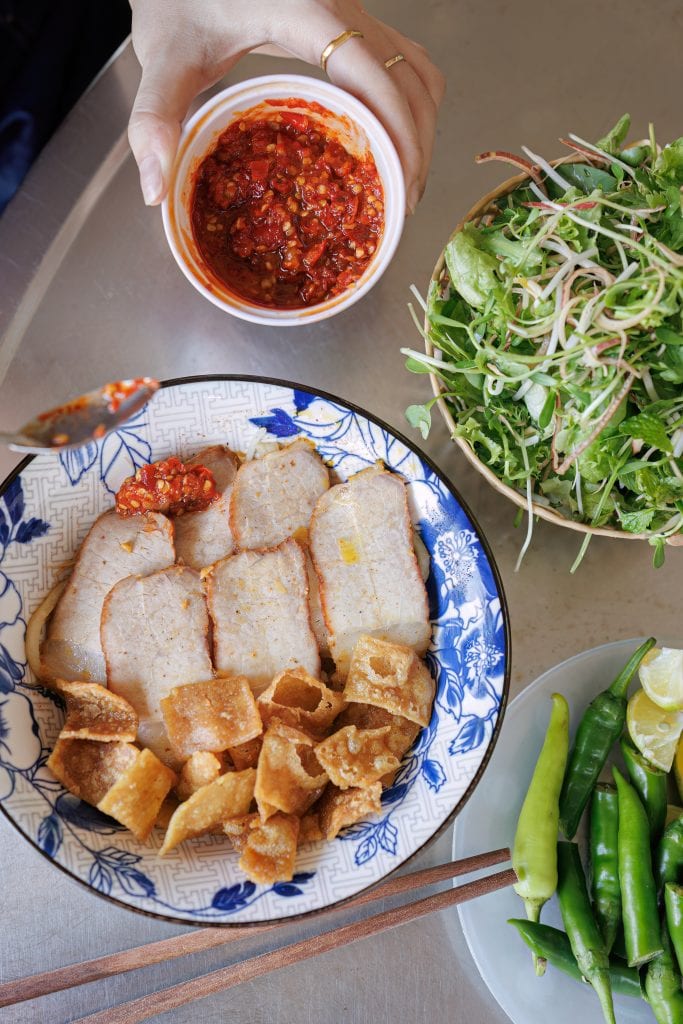
“Cao lầu’s sauce shines because of five-spice, soy sauce and the cooking juices that come from braising pork,” Hoa explained.
“The way we eat is by adding some chilli and a dash of added soy sauce… [that] really enhances the aroma.”
Beyond that, Hoa advices to “keep it simple and don’t change the dish too much”, an ode to her slight disappointment with how some inner-old town establishments are modifying the dish with non-conventional ingredients like eggs and beef.

Yet she isn’t inflexible by any measure.
For customers avoiding pork, she can also make a great bowl of cao lầu with chicken topping usually reserved for her family’s other specialty, Mì Quảng.
“As far as we know, the secret to good Cao lầu noodles is using water low in Alum content,” Hoa divulged further.
Bá Lễ Well’s water is seen as the traditional standard, but urbanisation and the growth of demand has turned the well into a site of historic preservation.
Today, Cao lầu noodle factories use high-quality water from other freshwater sources, while the reason behind why freshwater low in alum is sought after may well be attributed to potential problems introduced by alum’s acidity which counteracts alkaline ash water’s ability to gelatinize starch — a process paramount for forming Cao lầu’s unique texture and gray-yellow color.
From Hong Kong’s springy wonton noodles to Hakata’s Tonkotsu Ramen made with kansui, wheat-based noodles made using alkaline water may be common throughout Asia, but Cao lầu stands out as distinct in the world of rice-based noodles.
“It’s all down to handmade noodles, well-seasoned meat, coriander and basil,” Hoa concluded.
Cao Lầu Bá Lễ Well and the defenders of Hội An culinary scene

“Broke the mouth, like we say in Hawaii”, Mike, a random retired American kiteboarder and fitness fanatic beside me said out loud, as he expressed how Cao Lầu’s deliciousness convinced him to abandon his strict carb-free diet for a meal at the last Hội An spot featured in this “story”.
Admittedly, I did not visit Quán Cao lầu Bá Lễ (49/3 Trần Hưng Đạo, Phường Minh An, Hội An, Quảng Nam, Việt Nam) with great expectations because of its somewhat backpacker like surroundings and decor. Yet I left impressed and more knowledgeable.
Despite being at the door-steps of the most touristy part of Hội An’s old town, owner Võ Thị Thu Thuỷ and her founder-aunty Võ Thị Thạnh have guarded the authenticity of the noodle dish for decades.
It all began with Madam Thạnh selling the dish off a carrying pole on Trần Phú street, not too far away from Hội An’s Japanese Bridge.
(Watch the very cool and very retro clip of Madam Thạnh here.)

Today, Cao lầu Bá Lễ (They have a facebook page in case you’re curious) is one of the last joints still adding crispy pork lard to their Cao Lầu, and probably the only spot in town that stubbornly insists on blanching its fresh noodles with a copper pot, something I attribute more to Bun bò Huế.
“Using a copper pot provides the right amount of heat for the right duration,” Võ Thị Thu Thuỷ explained rather seriously.
Yet arriving at the topic of changing times, Võ shared that Cao Lầu’s dish-defining braised pork was once made predominantly using pork belly. These days, health-conscious locals (and visitors) prefer loin that also has an appropriate texture for the dish.
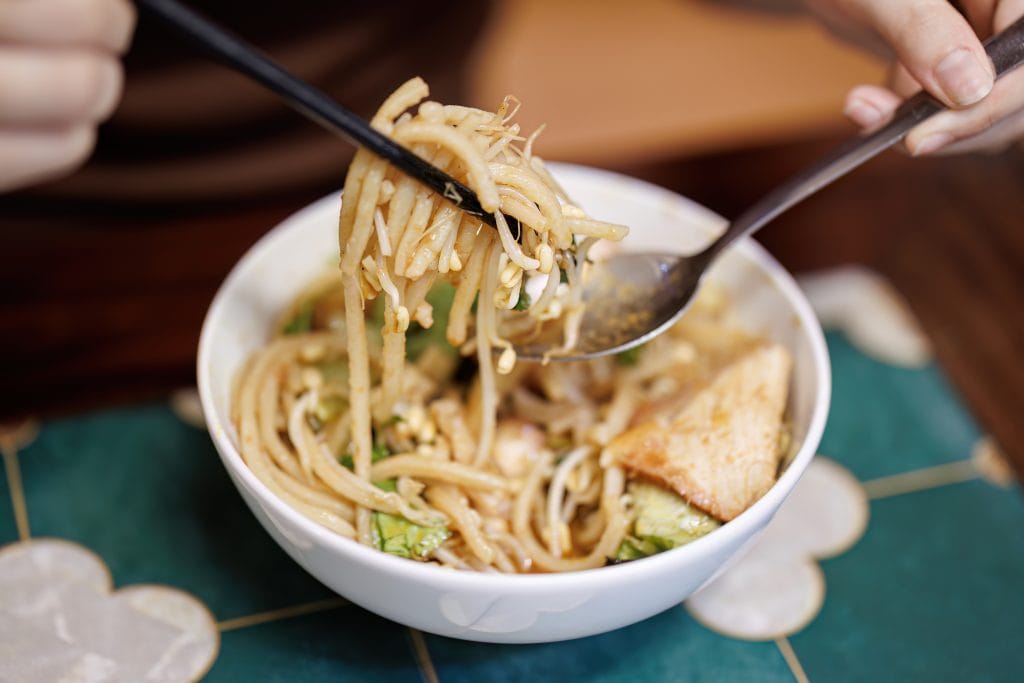
For her, it’s all about the recognisable flavor of Cù Lao Chàm’s ashwater and a generous amount of sauce made, agreed unanimously by all Cao lầu artisans in this article, by painstaking braising pork for hours. To balance the robust sauce, Cao lầu Bá Lễ also offers pickled shallots on the table for diners who like a touch of acidity.
She politely challenged me to try the dish at “less-popular” places, insisting that the taste of soy sauce usually dominates if one expends less effort, and ingredients, when braising pork.
“The soul of the dish might be the sauce, but every component matters for a good bowl of Cao lầu,” she added.
Going beyond and finding a bowl of Cao lầu in Ho Chi Minh City
I planned for the story to just end just there. Yet the irony of an age-old problem led me to extend the story for those hunting down the dish away from Hội An’s embracing foodie love.
Queue Cao lầu Cô Ba Ân, one of the only tasty Cao lầu noodle spots in Saigon that resembles anything out of Hội An.
With a name that translates directly and inadequately to tall building, Cao lầu’s name has been theorized as alluding to a dish consumed by richer merchants in Hội An’s old town. And despite the ever-increasing mass of skyscrapers in downtown Ho Chi Minh City, Cô Ba Ân has kept every generous serving of Cao lầu to just VND50,000 (US$2).

But making Cao Lầu well (no pun intended) in Vietnam’s largest city is by no means a walk in the park.
Beyond having to switch between 5 noodle makers and dealing with vast criticism from locals unfamiliar with the dish, owner and Đà Nẵng-native Nguyễn Huỳnh Nhuỵ Ân has managed to achieve a fine balance between Saigonese preferences and Central Vietnamese authenticity.
“Our signature bowl has two types of pork toppings — a grilled pork belly and the standard Cao lầu-style thịt xíu made with loin,” Ân explained.
Evidently, Saigonese locals love their protein very much. But diversity means that some customers eat Cao lầu noodles with just her crunchy deep-fried spring rolls — an innovation available only at Cao Lầu Cô Ba Ân.
The future of Cao Lầu and what lies ahead for Hội An’s cuisine
One can’t help but notice that the art of making Cao lầu isn’t just mere regional cuisine.
It’s a commitment to preserving Hội An’s unique cultural identity.
With most Cao lầu businesses now run by second and third generation owners who grew up with the trade and consequently a deep understanding of the dish and its nuances, I expect authentic flavors of the dish to persist for at least a few more decades to come.
The takeaway? Cao Lầu will stay, so long as its unique namesake alkaline rice noodles are still made.
“Many Cao Lầu vendors are now using machine-made noodles because many traditional makers have moved on [sic] or are experiencing the need to increase production quantity. I think our focus now is to get more people to know about Cao Lầu,” Nguyễn Huỳnh Nhuỵ Ân, owner of Cao Lầu Bà Ân, concludes.